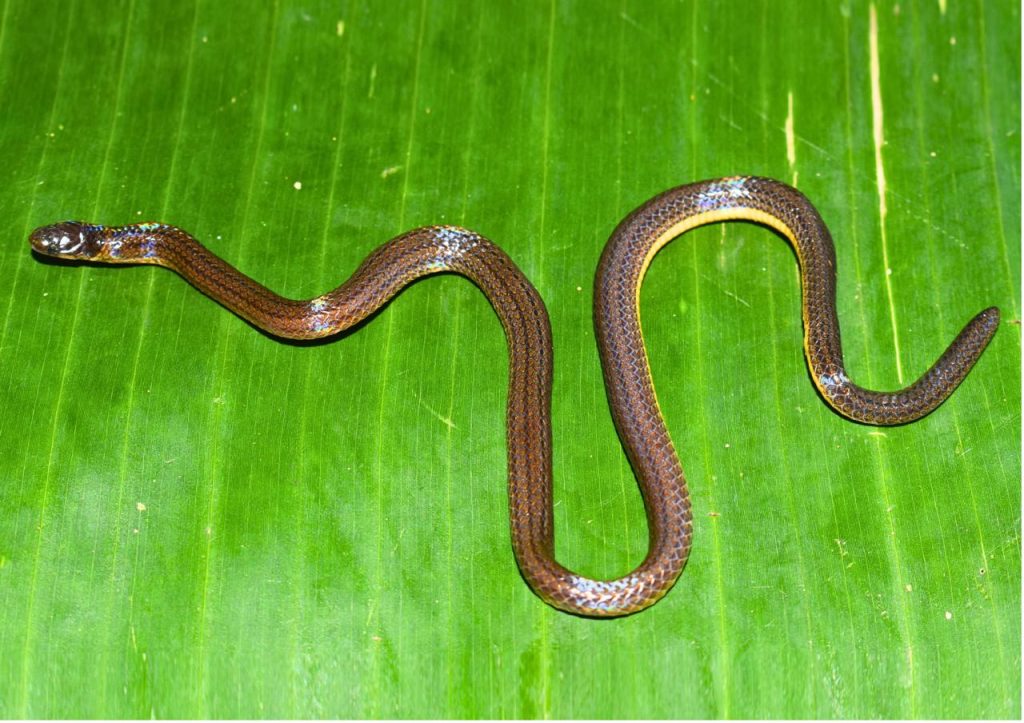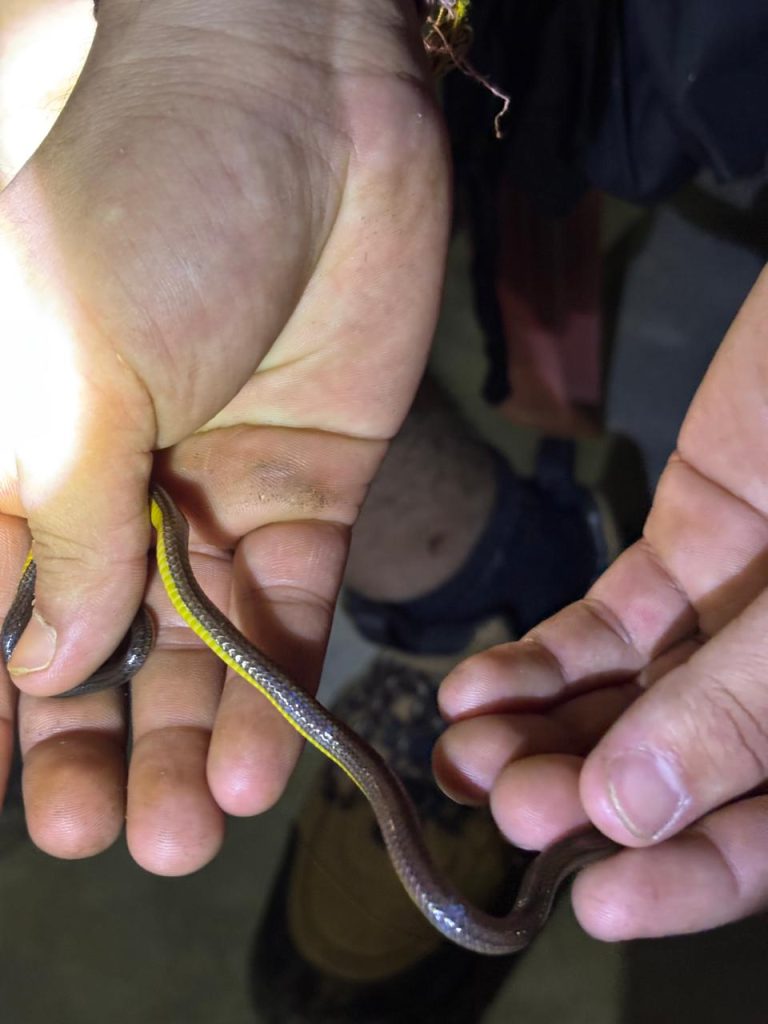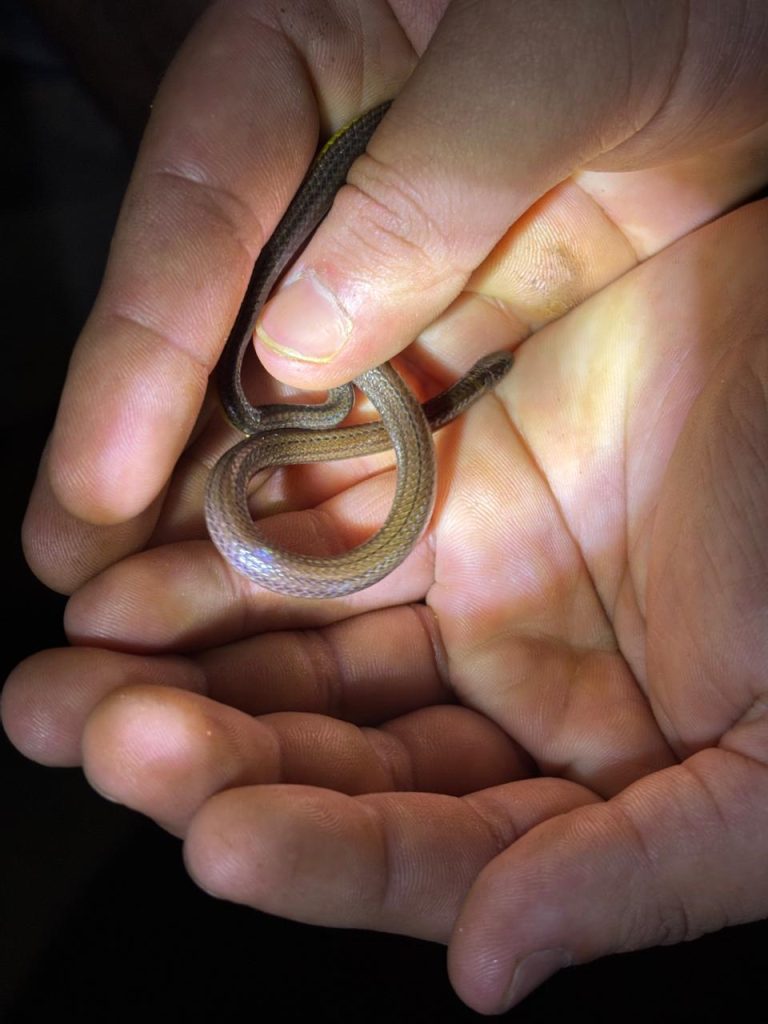
In a remarkable scientific breakthrough that underscores the rich yet underexplored biodiversity of Northeast India, a new species of fossorial reed snake has been discovered in the Garo Hills of Meghalaya. The species, named Calamaria garoensis (Garo Hills Reed Snake), has been formally described in the internationally reputed peer-reviewed journal Taprobanica. Earlier, the Chief Minister of Meghalaya, Shri Conrad K. Sangma, twitted a message congratulating Assam Don Bosco University on this achievement.
The discovery is the result of a collaborative research effort involving several premier institutions, including Assam Don Bosco University (ADBU), whose contribution proved significant in advancing the study. Other participating institutions include Help Earth, Cotton University, Mizoram University, the Zoological Survey of India, and Indonesia’s National Research & Innovation Agency (BRIN).
The research team comprised Manmath Bharali, Chesime M. Sangma, A.A. Thasun Amarasinghe, Sanath C. Bohra, Pranjal Swargiary, Griksrang C. Marak, Arup K. Hazarika, Madhurima Das, Bipin M. Asem, Jennifer Lyngdoh, Hmar T. Lalremsanga, and Jayaditya Purkayastha, bringing together a diverse pool of expertise in taxonomy, molecular biology, and field ecology.
The discovery was made during intensive field surveys conducted in the West Garo Hills district, with the holotype specimen collected from Oragitok in the Rongram Block, an ecologically rich and forested region. The species is currently known only from this locality, pointing to its restricted distribution and emphasizing the urgent need for conservation attention.
Researchers from Assam Don Bosco University played a crucial role in the integrative taxonomic analysis, particularly in supporting the molecular and phylogenetic components of the study. By combining classical morphological examination with mitochondrial DNA-based phylogenetic analysis, the team confirmed that the population represents a distinct evolutionary lineage. The findings revealed that Calamaria garoensis is closely related to Calamaria mizoramensis, yet genetically distinct, with a divergence of approximately 6.3%.
Reed snakes of the genus Calamaria are small, secretive, and predominantly burrowing, making them notoriously difficult to detect. Their subtle morphological differences have historically led to misidentifications, with many species previously grouped under broadly defined taxa. The present study not only identifies a new species but also addresses longstanding taxonomic ambiguities in the region.
Morphologically, Calamaria garoensis is distinguished by a unique combination of features, including smooth dorsal scales arranged in 13 rows, a short, non-tapering tail with an obtuse tip, and a prominent broad median black stripe on the underside of the tail. The body exhibits longitudinal striping along with a faint nuchal ring, traits that set it apart from related species.
Importantly, the study challenges earlier assumptions that reed snakes across Northeast India belonged to a single widespread species, Calamaria pavimentata. Instead, the findings suggest that what was once considered a single species is, in fact, a complex of multiple distinct lineages. This revelation calls for a re-examination of historical records and further systematic research.
The contribution of Assam Don Bosco University to this pioneering work highlights its growing prominence in biodiversity research and its commitment to scientific inquiry that serves both academic advancement and ecological conservation. The discovery of Calamaria garoensis not only enriches the region’s faunal inventory but also reinforces the global importance of Northeast India as a biodiversity hotspot worthy of sustained exploration and protection.
News Courtesy: Dr Jane Shangpliang, Dept. of Zoology, ADBU