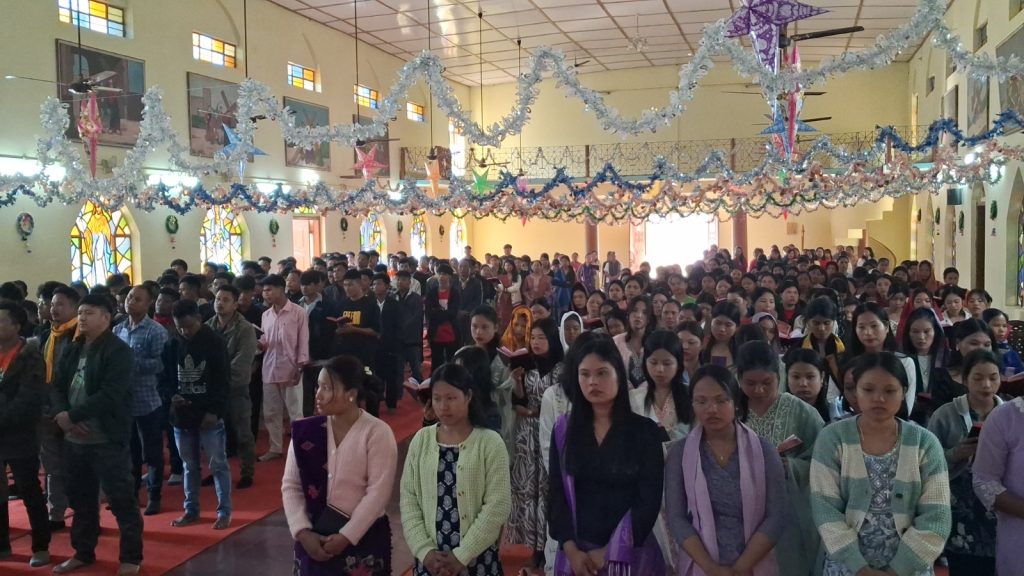
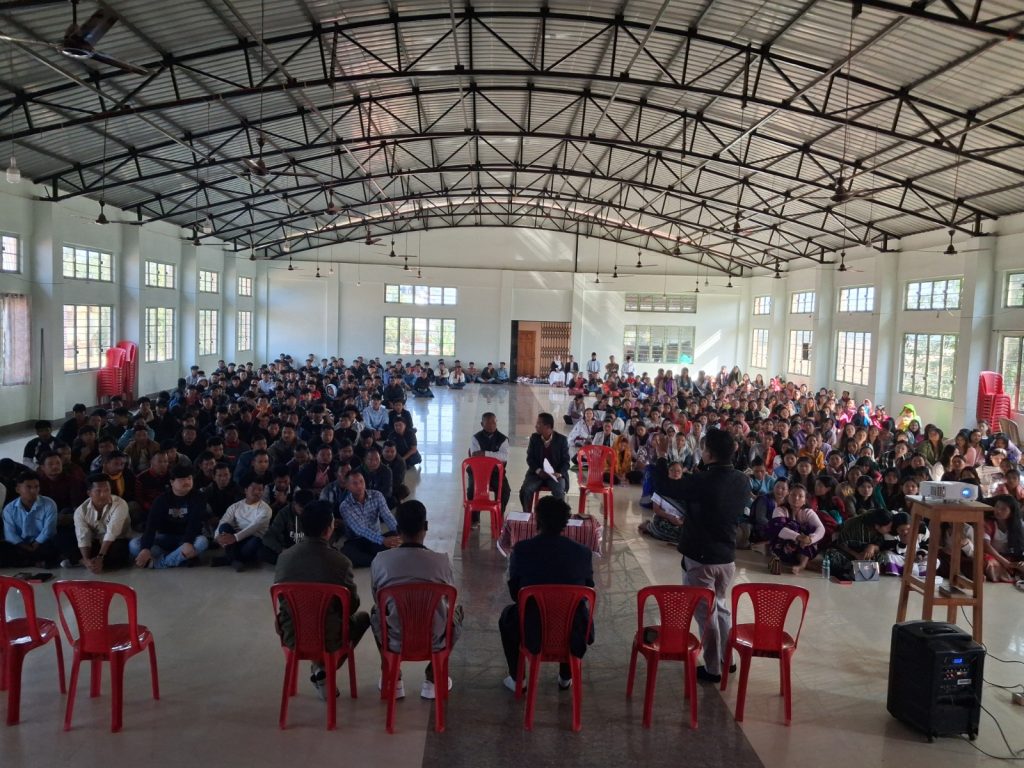
Youths from Satgaon during the celebration of Migrant Workers’ Day at Satgaon.
The Satgaon Migrant Desk of Mary Help of Christians Church, Satgaon parish, organized the Third Migrant Workers’ Day on 3 January 2026 at the parish premises. The annual initiative brought together approximately 600 migrant workers from the parish who had returned home for the Christmas holidays and are employed across various parts of the country.
The event was attended by resident Salesian priests and sisters, parish leaders, and local Church representatives. The key address was delivered by Fr. Charles Sangma, Assistant Parish Priest, who spoke on the theme “Spiritual Responsibilities of Migrant Workers.” Fr. Sangma emphasized that migration is a global reality, and the Church has historically accompanied migrants with pastoral care and spiritual support. He encouraged participants not to neglect their spiritual lives despite the challenges of living away from home, noting that spiritual nourishment can still be fostered even at a distance. He also urged young migrant workers to make meaningful use of the Annual Sobha, particularly by receiving the Sacrament of Confirmation, which is traditionally administered during the holiday season.
Earlier in the program, Fr. Albert Thyrniang, Parish Priest and Migrant Desk Director, presented an overview of the Satgaon Migrant Desk initiatives through a PowerPoint presentation. Drawing on real intervention cases, he explained that the desk’s core mission is to build strong networks with other Salesian migrant service desks nationwide. Among its major activities are the organization of the annual Migrant Workers’ Day in early January, awareness campaigns on migrant-related issues across parish groups, scheduled visits to migrant workers in their places of employment, and ongoing advocacy and support services.
During the Eucharistic celebration, Fr. Daniel highlighted the Holy Family’s own experience of migration, observing that Jesus, Mary, and Joseph were themselves migrants. The biblical story is a story of migration he noted. He commended the organizers for their sustained commitment to migrant ministry, which has become a widely recognized and impactful pastoral outreach of the parish.
Representatives of the migrant community expressed heartfelt appreciation for the initiative, acknowledging the importance of gathering migrant workers on a common platform for reflection and solidarity. They also reiterated essential labor rights, including the need for employer-issued ID cards, timely salary payments, Provident Fund (PF) benefits, insurance coverage, and access to other statutory welfare schemes.
The program concluded on a celebratory note as participants, predominantly young workers, took part in the traditional community dance set to the local Christmas hymn “Song Kirtan,” marking a joyful and culturally rooted end to the event before their departure.
Rev Fr Jogesh B. Sangma SDB speaking at the Inauguration of the Vocation Camp at Tura.
The Vocation Camp for the Garo Hills Region was solemnly inaugurated on 05th January 2026 at the Boys Home, Tura, with Rev. Fr. Jogesh B. Sangma SDB gracing the inaugural programme as the Chief Guest. The young participants, filled with enthusiasm and hope, were warmly welcomed to a time of prayer, discernment, and learning as they began their journey of vocational reflection.
In his address, Fr. Jogesh B. Sangma highlighted five key points that deeply enriched and motivated the participants. He began by explaining the meaning of the name Don Bosco, noting that “Don” means Father and “Bosco” is the name, thus reminding the young candidates of the deeply fatherly spirit that lies at the heart of the Salesian charism. This fatherly love, he said, continues to guide and nurture young people even today.
He described the Vocation Camp as a special time of grace and learning, inviting the participants to remain attentive and open to God’s voice. The camp, he emphasized, is not merely a programme but a sacred opportunity to listen, reflect, and discern God’s personal call in their lives.
Speaking about the Salesian Congregation, Fr. Jogesh underlined its missionary nature, which constantly challenges young people to embrace courage, sacrifice, and a generous response to God’s mission, especially among the young and the poor. He encouraged the participants to dream big and not to be afraid of giving their lives fully in service of God and others.
Reflecting on the Oratory, he traced its origins to Don Bosco’s vision of a space that is a home, a school, a parish, and a playground. He explained how this holistic approach to formation continues to shape the Salesian mission, fostering the intellectual, spiritual, social, and emotional growth of the young.
Concluding his address, Fr. Jogesh B. Sangma expressed his heartfelt gratitude to Rev. Fr. Threnius N. Sangma SDB, Rector of the Boys Home at Tura, the community members of Boys Home, Rev. Fr. John Mathias M. Marak, SDB, Vocation Promoter and the entire Vocation Team for their dedicated accompaniment and guidance of the young candidates. He assured them of his prayers and encouragement as they continue to walk with the young on their journey of discernment.
THE VICAR OF THE RECTOR MAJOR, Fr Stefano Martoglio, SDB
Dear friends and readers, members of the Salesian Family, for this month’s greeting in the Salesian Bulletin I will focus on a very important event that the Salesian Congregation is holding presently: General Chapter XXIX. This assembly, the most important one that the Congregation can experience, occurs every six years along the Salesian Congregation’s journey.
Our lives are filled with many things and this Jubilee Year proposes to us many important events; however, I want to focus on a different, particular one because, even if it would seem outside one’s realm, still, it concerns all of us.
Don Bosco, our Founder, was aware that things would not end with him but that it was only the beginning of a long journey to be traveled. One day in 1875, when he was sixty years old, Don Bosco said to Don Giulio Barberis, one of his closest collaborators: “You will finish the work I am beginning; I am making the sketch, you will add the colors” […] I will make a rough copy of the Congregation and I will leave to those who come after me the task of making it beautiful.”
With this happy and prophetic expression, Don Bosco outlined the path that we are all called to take. Its highest form is what we are carrying out at this time in Valdocco: the General Chapter of the Salesians of Don Bosco.
The prophecy of the caramels
Today’s world is like that of Don Bosco, but there is a common characteristic: it is a time of profound change. Total, balanced, and responsible humanization [of his boys] in both their material and spiritual components was Don Bosco’s true goal. He was concerned with filling the “inner space” of the boys, making “well-formed minds”, “virtuous citizens”. In today’s world, this is more relevant than ever. Our world needs Don Bosco today.
Before all else, everyone must pose to him or herself one simple question: “Do I want an ordinary life or do I want to change the world?” But can we even still speak of goals and ideals today? Whenever a river stops flowing, it turns into a swamp – even so with man.
Don Bosco never stopped moving forward. Today he does so with our feet.
His conviction about young people was this: “This most precious segment of human society, upon whom all hopes of a… happy future are founded, is not of itself of a bad disposition… If at times these youngsters are already infected with evil, it is more often through thoughtlessness than through deliberate malice. These youngsters truly need a helping hand to take care of them and to lead them away from evil to the practice of virtue…”
In 1882, in a conference to the Cooperators in Genoa: “By removing, instructing, and educating young people in danger, it is good for the whole of civil society. If young people are well educated, we will have a better generation over time.” It is as if to say: only education can change the world.
Don Bosco had an almost frightening capacity for vision. He never says “until now” but always “from now on.”
Guy Avanzini, an eminent university professor, always repeated: “The pedagogy of the twenty-first century will be Salesian, or it will not be.”
One evening in 1851, from a window on the second floor, Don Bosco flung a handful of caramels. Naturally, this resulted in great joy. One of the boys seeing him there, smiling at the window, yelled up to him: “Don Bosco, how wonderful it would be if you could see the whole world studded with oratories!” Don Bosco fixed his serene gaze toward the horizon and responded, “Who knows? The day may come when Oratory boys will really be scattered all over the earth!”
Don Bosco fixed his serene gaze heavenward and replied: “Who knows, the day may come when the sons of the oratory are truly scattered throughout the world.”
Looking Far Beyond
But what is a General Chapter? Why fill these pages with a theme that is specific to the Salesian Congregation?
The Constitutions of the Salesians of Don Bosco, their way of life, in article 146, define it as follows: “The general chapter is the principal sign of the Congregation’s unity in diversity. It is the fraternal meeting in which Salesians carry out a communal reflection to keep themselves faithful to the Gospel and to their Founder’s charism, and sensitive to the needs of time and place.
Through the general chapter the entire Society, opening itself to the guidance of the Spirit of the Lord, seeks to discern God’s will at a specific moment in history for the purpose of rendering the Church better service.“
The General Chapter is therefore not a private matter of consecrated Salesians, but a very important assembly that concerns us all, touching the whole Salesian Family and those who have Don Bosco within them, because the people, the mission, the Charism of Don Bosco, the Church and each one of us, of you, are at the center.
Fidelity to God and to Don Bosco along with the ability to see the signs of the times and of different places are also at the center. This fidelity is a continuous movement, renewal, and the ability to look far ahead while keeping one’s feet firmly planted on the ground.
For this reason, about 250 Salesian confreres from all over the world have gathered to pray, think, dialogue with each other, and look far beyond… in fidelity to Don Bosco.
Then after having constructed their vision, they will elect the new Rector Major, the successor of Don Bosco and his General Council.
This Chapter is not something extraneous to your life, dear friend who is reading this, but is part of your life and your “affection” for Don Bosco. Why tell you this? So that you will accompany it with your prayer – prayer to the Holy Spirit that He may help all the capitulars know what is God’s Will so we may give better service to the Church.
I think that GC29 – no, I am sure – will be all this: an experience of God that will help us “clean up” some parts of the sketch that Don Bosco left us, as all the General Chapters in the history of the Congregation have done before, always in fidelity to his plan.
I am certain that even today we can continue to be enlightened so as to be faithful to the Lord Jesus and our original charism with the faces, music, and colors of today.
We are not alone in this mission and we know and feel that Mary, our Mother and Help of Christians, the Help of the Church and model of fidelity, will sustain all our steps.
Fr. Stefano Martoglio, Vicar of the Rector Major explained the “leap” from the first thematic core to the members of the GC 29.
(ANS – Turin) – The participants of GC29 have chosen to begin each assembly meeting with a meditation. This was also the case on Thursday, March 6, when Fr. Eunan McDonnell was once again invited to lead the reflection. The meditation was anchored in the Word of God, specifically Romans 12:2: “Let yourselves be transformed by God with a complete renewal of your mind.”
The importance of discerning “what is good and pleasing to God” at this stage of the Chapter quickly became evident from the introduction given by Fr. Stefano Martoglio. He explained that the “leap” from the first thematic core, which focused on the life of the Salesian, to the third thematic core, which concerns the governance and animation of the Congregation, was driven by the need to secure Vatican approval for any decisions affecting elements of the Salesian Constitutions.
To ensure the Chapter members had a thorough understanding of these issues, two key reports were presented. The first, by Fr. Pascual Chávez, summarized the historical changes in the composition of the General Council and the Salesian Regions. The second, by Fr. Pier Fausto Frisoli, outlined the technical steps required to implement the decisions made in this Chapter.
Fr. Chávez recalled that since the Second Vatican Council—a pivotal moment of renewal initiated by the Holy Spirit—the Church has required all religious orders to update their statutes and governance structures. The Salesians dedicated three “extraordinary” General Chapters to adapting the Congregation to these new times. As he explained:
GC19, held during the Council, raised awareness and prepared the groundwork.GCS20, which lasted nine months, set the new structures in motion.GC21 revised, corrected, confirmed, and deepened the changes.GC22 was tasked with re-examining, refining, completing, and finalizing the process.
Throughout these transformations, the challenge was to maintain unity within the vast Salesian congregation while allowing greater autonomy at the local level. According to Fr. Chávez, all governance adaptations had to serve both a synchronous function (ensuring unity through the central sectors or departments) and a diachronic function (allowing decentralization through the Regions).
Fr. Frisoli then directed the Chapter members’ attention to three crucial topics requiring their deliberation:
The configuration of the Regions – Based on an analysis of reports from provincial chapters, 64 times the need to divide the current Africa-Madagascar Region into two distinct areas has been highlighted. The composition of the General Council – The number of Council members must align with the updated definition of the Congregation’s departments. This will determine how many members are to be elected (currently, there are five). Eligibility requirements for the Rectors Major, Provincials, and Rectors – A rescript issued by Pope Francis on May 18, 2022, allows religious superiors to be chosen from among non-priest confreres. While the first point will be addressed in the next six-year period based on GC29 decisions, the other two directly impact the election of the Rector Major and the General Councillors, as they require modifications to the Salesian Constitutions (Article 133 for point 2; Articles 162, 177, and 189 for point 3). Consequently, Vatican approval for any changes must be secured in time, as in just two weeks, the selection process for candidates to the various leadership roles will begin.
(ANS – Turin) – “Everything is clear?” repeats the Moderator, Fr. Alphonse Owoudou, from time to time to the Chapter members engaged in the work of the 29th General Chapter (GC29). The question, simple yet incisive, reflects the complexity and importance of the processes underway. The synodal working method adopted, which requires careful and shared reflection, aims to formulate clear proposals faithful to the prevailing thoughts of the participants. These guidelines will serve as the basis for the decisive deliberations that will shape the future of the Congregation.
Transparency has been identified as a key element of the decision-making process. Not just formal transparency, guaranteed by the collegial reading and approval of the minutes, but above all substantial transparency: the level of decisions being made is high, and every contribution must be carefully considered.
The most relevant aspects, which will impact the next six years, concern both the structure of the Congregation and the people who will have the task of realizing it with fidelity and dedication. For this reason, the importance of free, constructive, and open discussions was emphasized. Each Chapter member is called to actively participate, avoiding that important decisions are made based on ideas that may be fascinating but not sufficiently thought through.
The President, Fr. Stefano Martoglio, stressed the need to address each issue with calmness and precision: “The method and the time are ours!” This patient and methodical approach proved particularly necessary in addressing the third thematic nucleus of GC29, which concerns aligning Salesians worldwide with the challenges and opportunities of the present moment.
Friday, March 7, was marked by three important moments of assembly synthesis, during which the reports prepared by the six Commissions were presented and discussed. The goal was to share the guidelines that received the most consensus in the working groups, identifying precise formulations to be submitted to the plenary assembly.
The morning’s work focused on initial points, while the rest of the day was dedicated to “refining” the proposals. In the evening, the Chapter members were able to discuss five draft deliberations, which included topics of great relevance such as: the division of the Africa-Madagascar Region, in response to the need for better coordination and support; and the clarification of the tasks of the Regional Councillors, considering the expansion of responsibilities and the increasing dynamism of the Regions. These proposals represent the fruit of synodal and shared work, which takes into account global challenges and the specific needs of the various Salesian realities.
At the end of the day, the Chapter members experienced a moment of intense spirituality with the celebration of the Way of the Cross, animated by texts and images prepared by the East Asia-Oceania Region. This time of prayer and reflection provided an opportunity to renew the community spirit and entrust the Chapter’s work to the Lord so that it may be guided by His light.
The day of March 7 once again demonstrated the importance of synodal work that aims for clarity, participation, and transparency. Guided by a patient and shared method, the Chapter members are addressing the crucial issues that will determine the future of the Congregation. The journey of CG29 continues, with the awareness that every decision made today will help shape a Congregation even more faithful to Don Bosco’s charism and capable of responding to the needs of young people around the world.
(ANS – Turin) – Saturday, March 8, at the 29th General Chapter (CG29), marked a pivotal moment of transition, as the Chapter moved from analytical work to drafting recommendations for the future General Council regarding the governance of the Congregation. It was a significant day, during which the Chapter members immersed themselves in a blend of reflection, study, and voting simulations, all in preparation for the critical decisions set to be formally made next Monday.
While waiting for the final texts of the five Deliberations resulting from the work of the Commissions – which could be amended until 6:00 p.m. – the assembly had the opportunity to reread the documents together and informally assess the degree of shared consensus on the proposed formulations. This process not only allowed the Chapter members to carefully examine the texts but also to measure the level of approval for the ideas behind them, making the work more participatory and transparent.
During the session, the Chapter President, Fr. Stefano Martoglio, invited Fr. Pier Fausto Frisoli to provide clarifications on the total number of voters. Of the 227 Chapter members present, 7 do not have voting rights, while the 4 absentees yesterday (for various reasons) did not affect the total. Fr. Frisoli emphasized that each Chapter member expresses themselves on behalf of their Province, underlining the importance of a moral commitment to actively participate in the decision-making process. As evidence of this sense of responsibility, the first informal vote recorded 100% participation from those entitled to vote.
The five Deliberations under examination received significant support from the assembly, although about 16% of voters expressed concerns about certain points. This prompted the Chapter members to formulate improvement proposals, leaving room for further reflection. The General Secretariat will have the task, over the weekend, of integrating the proposed amendments, while many Chapter members will participate in a cultural trip to Savona and Alassio.
A particularly meaningful moment of the day was the intervention of Fr. Pascual Chávez, who was asked to retrace some key stages in the Congregation’s history in the decades following the Second Vatican Council. The former Rector Major summarized the content and challenges faced during General Chapters 23, 24, and 25, highlighting how the Salesians have remained faithful to the core of their charism, even amidst profound cultural and geopolitical transformations.
Fr. Chávez recalled that CG23 focused on educating young people in faith, identifying a specific youth spirituality, strengthened by the celebration of the centenary of Don Bosco’s death, an event that confirmed the Church’s attention to new generations.
CG24, on the other hand, marked a turning point in the consideration of laypeople within the Church and the Salesian mission. “Twenty-one laypeople were present and participated in the Chapter for its entire duration,” Fr. Chávez recalled, emphasizing that their participation should not be seen as mere collaboration but as genuine co-responsibility in Salesian life.
Finally, CG25 focused attention on fraternity within Salesian communities, seeking to overcome “the dichotomy between the need for communion and the saturation of community life,” a condition that often led to the loneliness of many confreres.
The morning concluded with the Eucharistic celebration presided over by Fr. Bosco Zaya Aung, Superior of the Myanmar Vice-Province. During the liturgy, which took place in the context of the first Friday of Lent, a prayer was offered for the population of Myanmar and all countries affected by armed conflicts. The situation in Myanmar remains dramatic: since the military coup four years ago, the country has been devastated by a civil war that has caused over 55,000 deaths and 3 million displaced people.
Chapter members from territories marked by conflict are direct witnesses to the suffering afflicting their populations, and the moment of prayer provided an opportunity to entrust to the Lord the hopes for peace and justice.
The day of March 8 represented an important transitional step for CG29, combining moments of reflection and practical participation. Through synodal work, the Chapter members continue to build a path of clarity and co-responsibility, aware that every decision made will help shape the future of the Congregation. The journey continues with confidence, illuminated by Don Bosco’s charism and the mission to respond to the needs of young people around the world.
A consensus emerged at the GC29 Assembly in favour of separating the Africa-Madagascar Region and including Croatia in the Mediterranean Region. However, there were differing opinions on the extent of the changes to be made, from transforming two Sectors, Communication and Missions, into Secretariats directly under the Rector Major to refining the roles and tools available to the current Sectors and Regions within the General Council.
The Assembly’s discussions focused on hearing reports from the representatives of the six Commissions to analyze the proposed three thematic areas. Deliberations on the structure of the future General Council and the configuration of the Regions were the subjects of deliberations, which were formally put to a vote by Monday, March 10.
Many participants admitted they were not yet fully prepared to make decisions on organizational aspects, as they lacked sufficient insight into the mechanisms behind them. As a result, questions and requests for more time were encouraged since, regardless of GC29’s official deadlines, every Salesian present would leave with a greater awareness of the vast and complex system in which they operate.
Beyond the voting results—all proposed deliberations were approved—what stood out was the reasoning behind each position. The President welcomed these perspectives as they contributed to a deeper understanding of the Congregation’s structure for governance and animation. Fr. Martoglio reaffirmed, “We are all experiencing a strong sense of responsibility and the high quality of the work done, where everyone engaged in everything.”
Moreover, discussions in both the Commissions and the Assembly often touched on broader cultural and pastoral challenges faced by the Sectors and Regions, including: • Formation and animation within Provinces in an international context; • The mission within a new framework of constant exchange between confreres; • The need to prevent structural inertia from slowing progress; • Commitment to following the Church’s call to be “outgoing”; • The evolving role of laypeople, who are increasingly present in leadership positions; • The evangelizing role of communication in an increasingly “distracted” society.