
A Concise History of the Archdiocese of Guwahati
The Archdiocese of Guwahati has the territory consisting of 7 districts – Kamrup (Metro), Kamrup (Rural), Goalpara, Nagaon, Morigaon, Hojai and Tamulpur of the state of Assam.
Two Portuguese Jesuit Missionaries, Cabral and Cacella— the first Christian Missionaries to set foot in Assam—reached Hajo and Guwahati on September 26, 1626. They were enroute to Tibet from Hooghly.
In June 1850, Fr. Robin, Fr. Krick and Fr. Bernardi of the Institute of the Foreign Missions of Paris reached Guwahati. Fr. Robin tried to learn Assamese and establish a centre. Fr. Krick proceeded to Nagaon and from there to Dibrugarh with the intention of going to Tibet. In 1854, Fr. Krick and Fr. Bourry were killed in the Mishmi Hills while trying to enter Tibet. Fr. Jacopo Broy of the Institute of the Foreign Missions of Milan took up residence in Guwahati and built a brick church here in 1883. From this central place he looked after the entire ‘Assam Missions’. Soon we find him in Nagaon where he later built a small church.
In 1889, the Prefecture Apostolic of Assam was created with headquarters at Shillong and was entrusted to the German Salvatorian Fathers. In February 1890, the German Salvatorian Missionaries Frs. Gallus Schrole and Rudolph Fontaine reached Guwahati. They were the two great missionaries of the Assam Valley. By this time, many tribal Catholics from Chota Nagpur had come to work in the Tea Gardens of Assam. With the outbreak of World War I, the German Salvatorian Fathers were forced to 12 Archdiocese of Guwahati return to their country. The Jesuits of Kolkata looked after the Assam mission till the Holy See entrusted it to the Salesians of Don Bosco in 1921.
In 1922, the Salesians of Don Bosco arrived in Northeast India under the leadership of Fr. Louis Mathias. In 1923, Fr. Leo Piasecki took charge of the Mission in Guwahati, which at that time covered the entire Brahmaputra Valley, Nagaland and Manipur. Assam Mission then consisted of the whole of Northeast India. Shillong was the capital of undivided Assam. In 1934 when Shillong was made a Diocese, Msgr Louis Mathias SDB was appointed as its first Bishop. Msgr. Stephen Ferrando succeeded him in 1935.
From Guwahati missionary work reached out to Dibrugarh, Tezpur, Garo Hills and Bhutan. Some of the first Catholics of Manipur and Nagaland had studied at Guwahati.
The Diocese of Guwahati was erected by Pope John Paul II on August 16, 1992 with Bishop Thomas Menamparampil as its first Bishop. It was carved out of the Dioceses of Shillong, Tura and Tezpur, the last contributing the largest portion. It was elevated to the status of an Archdiocese on August 1, 1995 bifurcating it from the Ecclesiastical Province of Shillong. The suffragan Dioceses are Dibrugarh, Tezpur and Diphu. Dioceses of Bongaigaon, Itanagar and Miao, erected later, also form part of the Ecclesiastical Province of Guwahati.
The area of the Archdiocese covers 13,961 Sq.km with a population of approximately 7,347,961. A Catholic population of 57884 is spread over 46 parishes/Centres. Catholics are mainly from the tribal communities: Garos, Rabhas, Bodos, Karbis, Tiwas, Santals and Adivasis.
Patron: St. John Bosco | Guwahati Archdiocese
Activities: Parish, Primary, Middle & High School, Evening School, Hr. Sec. School, Alumni, NIOS Study Centre
Don Bosco School
Pan Bazar, Guwahati – 781 001, Assam
Website: www.donboscoguwahati.net
Parish – St. Joseph’s Co-Cathedral
Don Bosco, Guwahati – 781001, Assam
Tel: (0361) 2543810: H |2606088: HM
Tel Fax: 2606033 | 2540583: School | 2510410: PP
St. Mary’s Convent FMA | Tel: (0361) 2664997
Don Bosco, Guwahati (Pan Bazar), instituted as a Salesian Community in 1926, has two important dimensions, namely St Joseph’s Parish and Don Bosco School. In 1922, when the first group of Salesians took up responsibility for the Assam Missions, Fr Giuseppe Gill and Br Laureano Santana were assigned to Guwahati. They initiated the primary school for boys, the carpentry and the catechists training centre at Guwahati. In 1926, the Salesian community was formally set up with Fr Leo Piasecki as the Rector. By 1928, the workshop was enlarged and an orphanage (boarding) for boys was built. The house was named ‘Our Lady’s Orphanage’. In 1948, Our Lady’s Orphanage metamorphosed into Don Bosco School in Assamese medium. In 2008, the School celebrated its Diamond Jubilee. English medium was introduced in 1962 by popular demand.
In 1959, when the Salesian Province of Guwahati was created, its offices functioned from Don Bosco premises till the new Provincial House was built in 1971. In 1965, the boarding for boys (orphanage) stopped. Due to lack of room, the technical school was shifted to Maligaon in 1969. In 1980, Pre-primary and Primary classes were added. Thanks to the hard work and dedicated service of many, Don Bosco School emerged as one of the most prestigious schools under Secondary Education Board of Assam (SEBA). In 2006, the School got affiliated to Central Board of Secondary Education (CBSE). In 2009, Don Bosco obtained affiliation to commence senior secondary classes. From 2009 the School has changed from being a ‘Boys’ School’ to a ‘Co-ed’ School, by admitting girls in Class XI. It began to admit girls in Class 1 in 2010.
The establishment of a centre for the National Institute of Open School (NOIS), Tuition classes for the neighbourhood children, Literacy and Vocational courses for the out-of-school children are all efforts to make Don Bosco School accessible to young people from all strata of the society. Don Bosco School, bearing distinction in academic excellence as well as in sports and co-curricular activities, makes every innovative effort to transform itself into a Youth Resource Development Centre (YRDC).
The vision and commitment of past headmasters like Shri H.M. Das, Fr Patrick Burns, Fr Mathew Kadavunkal, Fr Thomas Vattoth, Fr Paul Kuttala, Fr Thomas Thekkekandam, Fr Joseph Thelekkatt, Fr Sebastian Vadakethamikal, Fr Thomas Vattathara, Fr George Mudakkampuram, Fr Matthew Vellankal, Fr Kuriala Chittattukalam, Fr Joseph Thelekkatt and Fr Anthony Thekkel have placed the School at par with other premier schools in the country. Fr Sebastian Kuricheal was appointed Principal of the school 2014. Other Salesians who worked in the school are Fr Joseph Parippil, Fr Augustine Karottupuram, Br Abraham Vazhamplackal, Fr Chacko Kuthur Vellattukara, Fr Lukose Cheruvalel, Fr Marcus Lakra, Fr Santosh Minj, Fr Johnson Parackal, Fr George Rajendran (now bishop), Fr Damian Basumatary, Fr Benny Mushahary, Fr Saju Kariyil, Fr Jose Thiruthanathy, Fr Pradeep Ekka, Fr Solomon Dennis Joseph, Fr Francis Cheeramban and Fr Xavier Beck. At Present, the School continues to excel under the guidance of Fr Sebastian Kuricheal (Principal), Fr Joseph Paulianmung (Assistant Headmaster) and Fr Vincent Xalxo (Rector &Parish Priest) with the collaboration of the dedicated staff.
STJOSEPH’SCO-CATHEDRALPARISH
St Joseph’s Co-Cathedral Parish, has its remote origin with the arrival of Fr Jacopo Broy (PIME) in 1872. In 1870, Propaganda Fide erected the new Prefecture Apostolic of Central Bengal with Krishnagar as its headquarters. The territories of Assam and Bhutan were adjoined to it. It was entrusted to PIME (Milan Foreign Mission Society) for missionary work. Fr Jacopo Broy of Venice, sent by PIME superiors, reached Guwahati on 10 June 1872. On 14 July 1883, Fr Broy blessed a small chapel and a residence at Guwahati. The chapel was dedicated to St Joseph. The Catholic community under Fr Broy’s care numbered less than one hundred, mostly Europeans and Anglo Indians and a few Indians. But they were scattered in the length and breadth of Assam. Against all the odds, Fr Broy cared for the flock till the arrival of the Salvatorians (SDS) in 1890. By 1892, Fr Gallus Schoeb SDS took up residence at Guwahati and continued the work of Fr Broy. In spite of opposition from some quarters, Fr Gallus began to turn his attention to the tea garden workers. In 1897, the chapel at Guwahati was destroyed in an earthquake. He bought a plot of land adjacent to the old one and built a new residence and chapel. Fr Gallus returned to Europe in October 1906, having suffered a nervous breakdown. Fr Rudolf Fontaine SDS succeeded him at Guwahati. Under Fr Rudolf the missionary work in the Assam Valley extended among the Tea Garden workers. On 1 January 1910, the foundation stone for a new church at Guwahati was laid by Fr Edward Hackenbrosch and the blessing of the church took place on 27 November 1910. The work of the Salvatorian missionaries came to an abrupt end with their expulsion from the country due to World War I in 1915. In the following years, the Jesuits from Calcutta looked after the spiritual needs of the faithful.
With the arrival of the Salesians in Assam in 1922, the mission work received a boost. Fr Giuseppe Gil and Br Laureano Santana were the first Salesians assigned to Guwahati. They reached Guwahati on 1 March 1922. In a couple of months Fr Gil visited several towns, villages and tea estates of Assam, reaching up to Nowgong, Lakhimpur and Sibsagar. Towards the end of November 1922, Fr Leo Piasecki was sent to Guwahati as Assistant to Fr Gil. On 14 June 1925 Mgr Louis Mathias blessed the newly built larger church of Guwahati. The number of baptisms in the mission district of Guwahati in 1925 counted 500, mainly among the Garos and the Adivasis. In December 1925, Fr Gil was sent to begin the Salesian work in Calcutta; Fr Leo Piasecki was appointed superior of Guwahati mission. Few weeks later, Fr Francis Mormol joined him as Assistant. Two clerics Eligio Cinato and Mariano Camolese were sent in February 1926 to look after the boarding and to help at the Industrial School at the start. The Salesian Sisters who had reached Guwahati in 1923 began to care for the girls (work room and boarding) and look after the sick in the government hospital. Prior to the arrival of the Salesian Sisters, the Catechist Sisters of Mary Immaculate from Paris, France, who had reached Guwahati in 1913, worked for some years.
In 1928, Fr Piasecki started to publish a Hindi monthly called Salesian Khabaren(Salesian News) to instruct the people and to spread devotion to Our Lady. Clerics Orestes Marengo and Hubert Marocchino who were at Guwahati, helped with the preparation of the magazine. In 1929, Fr Efisio Sanna was sent to be in charge of the community at Guwahati, so that Fr Piasecki would be more free to reach out to the far away villages. In 1930, Fr Sanna was transferred to Calcutta, and Fr Vincent Scuderi was appointed rector and mission superior at Guwahati. In 1931, Guwahati mission district was divided into two: the districts of Dibrugarh and Guwahati. Fr Piasecki was moved to Dibrugarh. Fr Scuderi was made the superior of Guwahati. It consisted of five civil districts of Garo Hills, Goalpara, Kamrup, Darrang and Nowgong. Soon Fr Archimedes Pianazzi and Fr Anthony Alessi joined Guwahati and shared the responsibility. Fr Pianazzi looked after Garo Hills and Goalpara districts, while Fr Alessi would visit Darrang and Nowgong districts. In 1932, the Mission district of Guwahati was further divided; two new districts were created namely that of Tezpur and Dhubri. Fr Alessi went to Tezpur assisted by newly ordained Fr Aloysius Ravalico. The Mission district of Dhubri was to be manned by Fr Pianazzi helped by Fr Luigi Rocca, another newly ordained priest. Though the Guwahati Mission was reduced in size and number, the missionary activities flourished and number of baptisms increased among the Adivasis and Boros. In October 1934, Fr Orestes Marengo was made the mission superior of Guwahati. In the following year Fr Alessi was transferred from Tezpur and made superior of Guwahati so that Fr Marengo was left free to visit villages and baptize. At the end of 1938, Fr Alessi was assigned to pioneer Salesian mission in Burma. Fr Mario Ferrario, the new superior, reached Guwahati on 5 January 1939. On 18 February in the following year, Fr Attilio Colussi took over as the rector and mission superior of Guwahati.
During the years of World War II (1939-45), the mission work in Guwahati suffered much. Most of the Italian priests and the clerics were moved out of Guwahati, first to Shillong and then out of Assam. The Mission campus at Guwahati became shelter place for the refugees of World War II. The Salesians, priests and sisters, rendered most appreciable service to the wounded and sick soldiers of the War. Only by February 1948, the School began to function again; in the middle of 1949 Fr Luigi Arneodo replaced Fr Attilio Colussi as the rector of the house. Due to the request of civil authorities, the Mission opened a hostel for the students of Cotton College. But towards the end of the same year (1949), at the recommendation of Rev. Fr A. Fedrigotti during the extraordinary visitation, the hostel for the College students was closed down.
In the post-Independence years, the mission work continued to be carried out with much zeal. The dedicated work of Parish priests like Fr Patrick Burns (1969-73), Fr Mathew Kadavunkal (1973-79), Fr Thomas Punnolikunnel (1979-85), Fr Elias Kerketta (1985-89), Fr Lukose Cheruvalel (1989-91), Fr Augustine Karottupuram (1991-95), Fr Albano D’Mello (1995-2003), Fr Matthew Parackatte (2003-06), Fr Marcus Lakra (2006-2011), Fr Solomon Denis Joseph (2011-2012), Fr Jose Thiruthanathy (2012-2015) and Fr Francis Cheeramben (2015-2017) have contributed much to the growth of the Parish. From 2017 onwards, Fr Vincent Xalxo is serving as the Parish Priest.The present church building was constructed during the years 1989-1990 and was blessed by Most Rev. Hubert D’Rosario, the then Archbishop of Shillong-Guwahati, on 6 October 1990.In the decades past, the Catholic community increased in number; the number of diocesan priests grew; the religious institutions multiplied; new Parishes were opened; and the overall growth of the Church in the region resulted in the creation of the diocese of Guwahati in 1992. It became an Archdiocese in 1995 and St Joseph’s Parish Church served as the Cathedral Church of the Archdiocese. When the Archdiocese constructed a Cathedral at Rukmanigaon, Dispur, St Joseph’s Church was declared Co-Cathedral.
As per the latest statistics, the Parish has 2915 Catholics. The Catholic families number 522. Guwahati, being the gateway to the rest of north-east India and a cosmopolitan city, nearly fifty percent of the Catholic population is temporarily settled. There are two main Catholic village settlements, namely, Tonybasti and Darjeeling Basti. In the recent years, a number of religious congregations have set up their communities within the Parish. Various Lay Associations collaborate in the life and activities of the Parish.
Fr. Alex Kattakayam Fr Kishor Moshahary Fr Vincent Xalxo
(Principal) VP & Asst. PP Rector & PP
Patron: Michael the Archangel | Guwahati Archdiocese
Activities: Parish, Primary, Middle & High School, Hostel, Youth Animation, Animation for Catechists
Catholic Church
Damra – 783 122, Assam
Tel : (03663) 280045: House | 281509: School
Nirmala Convent MSMHC | Tel: (03663) 281627
The earliest contacts of the Salesian missionaries with Damra region dates back to the 1930s. As the number of Catholics increased, the need was felt to start a Mission centre for the Garo’s of the region. Karkutta was chosen as a possible centre and Fr Hubert Colzani reached there on 8 May 1946. But having found Damra more convenient place for the mission centre, Fr Colzani began the work there. Fr George Stadler soon joined. In 1951, Fr Battista Busolin replaced Fr Stadler.
In 1951, Fr Willy Schoofs took charge of the Mission. In the same year Don Bosco M.E. School (Garo Medium) was started. It was upgraded to High School in 1957. During his time, much of the infrastructure for the Parish and the Convent was built. An Assamese Medium M.E. School was opened in 1956, and in 1971 it was upgraded to a High School.
The Mission received further boost during the years when Fr Dominic Curto was the Parish Priest (1956-1969). In 1964, a large number of Garo Catholics migrated from Bangladesh and settled in the area. New villages were contacted and the number of Catholics steadily increased. Unfortunately, Fr Curto had to leave the Mission in 1969 following a quit order served by the government on foreign missionaries. Fr George Elavumkunnel, a diocesan priest, looked after the Mission during the years 1969-71. He began to contact the Rabha community.
In the successive years, Fr Victor Ampanattuvila, Fr Thomas Kochupurackal, Fr Paul Panachickal, Fr Jose Valiaveettil, Fr Barnabas Mardi, Fr John Chellanthara and Fr Milon Narjary served as Parish Priests. Others who worked in the Parish include Fr Martin Caligaris, Fr Alexander M.P. (diocesan priest), Fr Humbert Marocchino, Fr George Pooppalli MSFS, Fr Maria Selvam, Fr John Vadakkekuzhikattil, Fr Thomas Kunnamkudath and Fr George Ollickal MST and Fr Jose Thattil Umbavu.
The schools at the Mission made great progress, in spite of occasional difficulties. The pioneers were followed by equally committed missionaries like Fr Joseph Maliekal, Fr Kuriala Chittatukalam, Fr Augustine Karottupuram, Fr Cornelius Panna, Fr Augustine Edasserithottathil, Fr Michael Bengra, Br Barnabas Haw, Fr Andreas Panna, Br Benjamin Kujur, Fr Christopher Warlarpih, Fr Johnson Parackal, Fr Victor Tigga and Br Solomon Swer.
In 1992, the Mission became a canonically established Salesian Community under the patronage of St Michael the Archangel. At present the Salesian community at Damra consists of Fr Francis Kalariparampil (Rector and Parish Priest), Fr Albert T Sangma (Assistant Parish Priest and Headmaster, provincialized School) Br Nirmal Ekka (Headmaster, Don Bosco Colzani School) and Fr Francis Xavier Lakra (VP and Asst. PP). The Parish statistics of 2019 count about 4000 Catholics scattered in 72 villages. The main ethnic groups are Garos, Rabhas and Bodos. The Parish originally belonged to Shillong Archdiocese, then to the diocese of Tura and now it is part of Guwahati Archdiocese.
Damra Mission, can be rightly called the Mother Mission in the region, as it has given birth to numerous Parishes. Boko (1993), Mariampur (1995), Panishali (1995), Gojapara (1997), Goalpara (1998), Rangjuli (1998), Chhaygaon (2004), Matia (2005), Mallangkona (2007), Tillapara (2009), Loharghat (2010), Majerburi (2011) and Hahim (2013) in the Archdiocese of Guwahati were carved out from the territory of Damra. Similarly, in the diocese of Tura, the Parishes of Rongjeng (1971), Resubelpara (1971), William Nagar (1977), Mendal (1977), Mangsang (1979), Chima-Impel (1984), Nongalbibra (1989), Songsak (1992), Mendipathar (1995), Samanda (2000), Kharkutta (2004), Chidimit (2004), Dawagre (2005), Damas (2011) and Bajengdoba (2014) were once part of Damra Parish. The Nirmala Convent of the Missionary Sisters of Mary Help of Christians (MSMHC) was officially set up on 10 December 1975. The Sisters are actively involved in the Parish ministry, education, catechesis and health care.
On 24 January 2000, Rev. Fr Victor Ampanattuvila, the then Parish Priest, opened the Don Bosco Colzani School in order to educate the poor Catholics of the area. The school has grown in number over the years and a new school building was constructed and it was blessed on 13 May 2017. At present, the School has progressed to Class X and the first batch of students from the School will write their High School Leaving Examination in February 2020. Today there are 850 students enrolled in the school. In view of the visit of Rector Major in November 2017, the Church and the provincialized school building were renovated. The living rooms of the Salesians were reconditioned and the entire surrounding was given a face-lift in order to receive the successor of Don Bosco to the Centre.
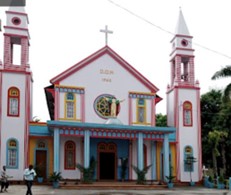 The Mission of Barpeta Road is one of the earliest Catholic establishments in the Assam valley. The region is an ethnic mosaic consisting of the Bodos, the Santals, the Adivasis, the Garos, the Rabhas and others. It is one of the important traditional cultural centres of the Assamese people. The Catholic Mission was officially established at Barpeta Road in 1936. The Mission had its primary aim to boost the evangelization work among the Boros.